
How Does a Solar Inverter Synchronize With the Grid?
The solar inverter goes beyond converting DC power to useful AC power. Another important function of the solar inverter is synchronization. This involves ensuring that the inverter matches the voltage, frequency, and phase of the grid before sending power to it. Failure to synchronize can lead to destruction of machinery or even danger to people.
Why Grid Synchronization Matters for Solar Inverters
The electric grid operates within narrow limits. In the case of North America, for instance, the electric grid runs at 60 Hz while being operated at specific voltages. For a solar inverter, the voltage and frequency must be adjusted before exporting energy into the electric grid.
If the system fails to synchronize with the electric grid, some complications arise:
- Power fluctuations
- Damage to equipment
- Protection system shutdown
- Hazards for electric utility technicians
That is why plug-and-play is not possible for grid-connected photovoltaic (PV) modules. In fact, the solar inverter monitors the electric grid and adjusts its performance accordingly.
Modern inverters do so automatically and continuously. They monitor the electric grid even after successful synchronization.
The Three Parameters a Solar Inverter Must Match
For the system to be able to connect with the grid, a solar inverter should synchronize three fundamental electrical parameters.
Grid Frequency Synchronization
It is mandatory for the solar inverter to synchronize the electrical grid frequency perfectly with the grid frequency. For example, if the grid runs on 60Hz frequency, the inverter should generate 60Hz alternating current.
Mismatching in frequency results into:
- Reverse power flow
- Oscillation in frequencies
- Invertor will automatically shut down
Internal oscillators in solar inverters ensure that there is proper tracking of frequency variations.
Grid Voltage Synchronization
Grid voltage synchronization is another essential aspect for ensuring that there is proper flow of electricity.
High grid voltage results into:
- Increased stress on equipment
- Over-tripping of protection circuitries
Low grid voltage results into:
- Ineffective flow of electricity
The solar inverter measures the grid voltage and generates its power at the same levels.
Phase Alignment
The Phase parameter can be the most important factor at times.
Alternating currents flow in wave form. To ensure proper connection, the wave form of the inverter should be in sync with that of the grid.
In case the two waves are out of sync:
- Current spikes become common
- There can be equipment damage
- There are even chances of the entire system being shut down
Solar inverters therefore use special methods to track the phases of the waveform.
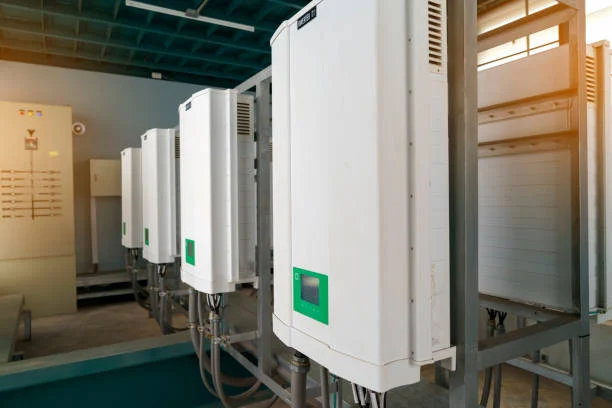
Grid Parameter Detection in Solar Inverters
A solar inverter first needs to analyze the grid parameters to synchronize with the grid.
The commonly used method in grid-tied inverters is Phase-Locked Loop (PLL). This means the inverter measures the following constantly:
- Waveform of the grid voltage
- Frequency
- Phase angle
The inverter will now make its own internal adjustments according to these readings.
This happens continually, not only when the system is first switched on. Should the grid change, the inverter will adjust immediately.
Real-time Monitoring and Control
Inverter technology used in modern solar panels makes millions of computations every single second. As a result, it can:
- Identify problems with the grid
- Smooth output fluctuations
- Ensure reliable injection of energy into the grid
What Happens During the Synchronization Process
A process takes place during the startup of an inverter which comprises the following steps:
Step 1: Grid Detection
This is a situation where the inverter detects the presence of grid voltage and its stability.
If this situation is not stable, the inverter remains dormant.
Step 2: Parameters’ measurement
The inverter takes the readings of:
- Voltage
- Frequency
- Phase
Step 3: Waveform Matching
This stage sees the inverter gradually aligning itself with the grid waveforms.
At this stage, the inverter does not experience any sudden power transfer from the source.
Step 4: Soft Connection
Here, after synchronizing with the grid, the inverter slowly connects to supply power to the grid.
Step 5: Continuous Adjustment
After successfully connecting to the grid, the inverter continuously monitors grid parameters.
How Modern Solar Inverters Maintain Grid Stability
Modern solar inverters go beyond synchronization by providing stability to the electrical network.
Some of these features that inverters possess include:
- Reactive power control
- Voltage control
- Frequency response
- Grid ancillary services
Through the above functions, solar inverters can mimic conventional power stations.
Inverter Control Algorithms in Grid-Tied Applications
In synchronization, control algorithms play an integral role in enabling proper performance from the inverter. Inverters operate under various control methods. Examples of these include:
- Phase locked loops (PLL)
- Droop control
- Grid forming control
- Grid following control
The study titled Synchronization and Control of a Single-Phase Grid-Tied Inverter under Harmonic Distortion, published by Simon Fraser University, shows that grid-tied inverters rely on synchronization mechanisms that track phase and frequency even under distorted grid conditions, allowing stable integration of solar generation into existing power networks.
This is a good reminder that grid conditions are rarely optimal. Disturbances such as harmonics, noises, and variations happen frequently. Synchronization enables the solar inverters to work effectively amid such scenarios.
What Occurs When the Grid is not Synchronized?
In case there is no synchronization, the solar inverters disconnect from the grid right away.
This is referred to as anti-islanding protection.
The following situations are avoided through anti-islanding:
- Providing energy into the isolated grid
- Creating hazardous work conditions
- Causing destruction to property
When the grid conditions are favorable once again, the inverter will synchronize again before rejoining the grid.
This protective measure is mandatory according to grid codes around the world.
Grid-Following vs Grid-Forming Solar Inverters
All inverters do not work in the same way.
Grid-following inverters
Residential PV systems mostly employ grid-following inverters.
These systems:
- Monitor the grid
- Synchronize the output
- Feed electricity to the grid
Their operation relies on the grid as a reference point.
Grid-forming inverters
Grid-forming inverters are sophisticated than their counterparts.
They can:
- Establish voltage stability
- Establish the frequency
- Facilitate microgrids
These systems have gained popularity due to high renewable integration.
Grid-forming inverters might play a crucial role in stabilizing isolated grids.
How Synchronization Affects Solar System Performance
Synchronization will lead to:
- Efficiency
- Reliability
- Safety
- Compatibility with the grid
On the contrary, poor synchronization results in:
- Shutdowns
- Less exported power
- Grid instability
That is why inverter quality plays an important role in solar applications.
Despite using the same solar panels, using different inverters will result in different outcomes.


Future Advancements in Solar Inverter Synchronization
As solar energy becomes more common, the evolution of solar inverter synchronization also goes on.
The current trends are:
- Use of AI in inverter control
- Faster reaction time
- Better grid formation ability
- Increased fault tolerance
These innovations will facilitate solar energy penetration into grids while maintaining their stability.
The demand for advanced synchronization from utilities will continue.
Conclusion
Grid synchronization takes place through voltage matching, frequency matching, and phase matching before energy transfer. Through monitoring and control algorithms, grid synchronization takes place all the time in modern inverters, automatically disconnecting whenever there is instability in the grid.
Solar power usage grows every day, and thus, grid synchronization technology gains greater importance. Selecting a good solar inverter with sophisticated grid support functions will make the system more efficient. When analyzing solar power generation, grid synchronization is one of the easiest ways of ensuring the greatest safety and efficiency.
About the Author